

 Home
Home
 National
 International
 Merit list
 Date Sheet
 Result
 Admission
 Study Abroad
.jpg)


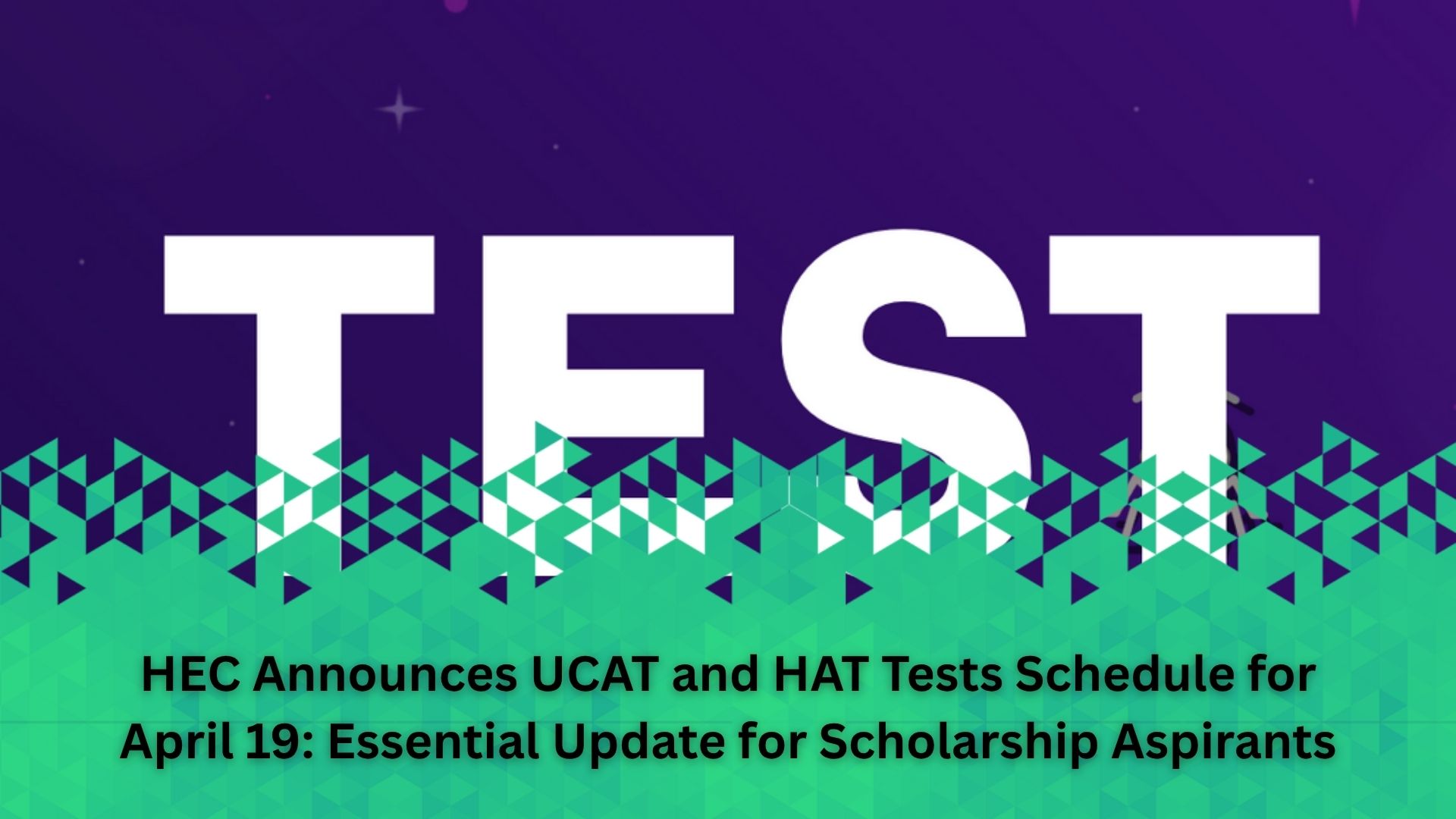
HEC Announces UCAT and HAT Tests Schedule for April 19: Essential Update for Scholarship Aspirants
The Higher Education Commission (HEC) Pakistan has officially released the schedule for two critical entrance examinations: the Undergraduate College Admission Test (UCAT) and the Higher Aptitude Test (HAT) . According to a notification issued by the commission, both tests will be conducted under HEC’s direct supervision on April 19th, 2026 , setting the stage for the upcoming cycle of international scholarship awards.
HEC Issues Strict Guidelines for Candidates and Faculty
Alongside the test schedule, the HEC has published a comprehensive set of guidelines for students, teachers, and academic institutions. The commission stressed that these tests are not merely formalities but are mandatory prerequisites for students seeking eligibility for foreign-funded scholarships .
Officials have advised candidates to begin rigorous preparation immediately, as the selection process for competitive international programs will prioritize those securing higher scores. “Strong performance in UCAT and HAT is a prerequisite for applying to most foreign scholarship opportunities,” an HEC representative stated. “Candidates are encouraged to prepare accordingly to improve their chances of selection.”
The HEC clarified that the UCAT is primarily designed for students applying to undergraduate programs abroad, while the HAT targets graduate and doctoral aspirants. Both examinations evaluate critical thinking, subject knowledge, and analytical aptitude skills deemed essential for success in international academic environments.
Role of Diplomatic Channels in Facilitating Scholarships
In its official communication, the Higher Education Commission highlighted its ongoing role in facilitating foreign-funded scholarships through diplomatic channels. These channels, the commission noted, allow Pakistani students to pursue higher education in various countries, including the United States, the United Kingdom, Germany, China, Turkey, and several Middle Eastern nations.
The commission stated that such opportunities are offered annually as part of a sustained effort to support academic growth and provide international exposure for Pakistani students. By coordinating with foreign embassies, cultural missions, and international universities, HEC ensures that scholarship programs are transparent, merit-based, and accessible to talented students across all provinces, including remote and underprivileged areas.
Warning Against Fraudulent Scholarship Schemes
In a particularly urgent section of its advisory, HEC cautioned students and faculty members to rely only on verified and authentic information regarding scholarships. The commission warned that unverified or fraudulent scholarship schemes are frequently circulated through unofficial sources, including social media platforms, fake websites, and unsolicited emails.
“Applicants are advised to avoid any unverified or fraudulent scholarship schemes circulating through unofficial sources,” the commission emphasized. HEC urged students to cross-check all scholarship announcements exclusively on the official HEC website (www.hec.gov.pk) and its verified social media channels. The commission also encouraged students to report suspicious scholarship offers to local law enforcement or HEC’s anti-fraud helpline.
Why the UCAT and HAT Matter for International Admissions
The announcement comes at a critical time when competition for foreign scholarships has intensified due to limited seats and high applicant volumes. HEC officials explained that most international partner universities and donor agencies now require Pakistani applicants to submit valid UCAT or HAT scores as part of their admission packages. Without these scores, students cannot even begin the application process for many prestigious programs, including the Commonwealth Scholarships, Fulbright Program, Stipendium Hungaricum, and various Chinese Government Scholarships.
Furthermore, the commission noted that the April 19 test dates allow sufficient time for score processing, enabling successful candidates to meet the application deadlines for Fall 2026 and Spring 2027 international admission cycles.
Preparation Tips and Test-Day Logistics
To assist candidates, HEC has released sample papers, syllabus guidelines, and preparation resources on its official portal. Students are advised to register early, as test centers have limited capacity. The tests will be held simultaneously in major cities across Pakistan, including Karachi, Lahore, Islamabad, Peshawar, Quetta, Multan, and Faisalabad.
On test day, candidates must bring original CNICs/B-Forms, printed roll number slips, and strictly prohibited items such as mobile phones or smartwatches will not be allowed inside examination halls. HEC has also assured that strict anti-cheating measures will be enforced to ensure fairness and transparency.

Final Words of Encouragement
While the announcement carries a tone of urgency and strictness, HEC officials also offered words of encouragement. They reminded students that these tests are designed to identify genuine talent and that hard work, consistent study, and reliance on authentic information are the keys to success.
“These opportunities are life-changing,” an HEC official added. “Perform well, stay vigilant against fraud, and you can secure a future that not only benefits you but also contributes to Pakistan’s academic and professional landscape.”