




 Home
Home
 National
 International
 Merit list
 Date Sheet
 Result
 Admission
 Study Abroad


.jpg)
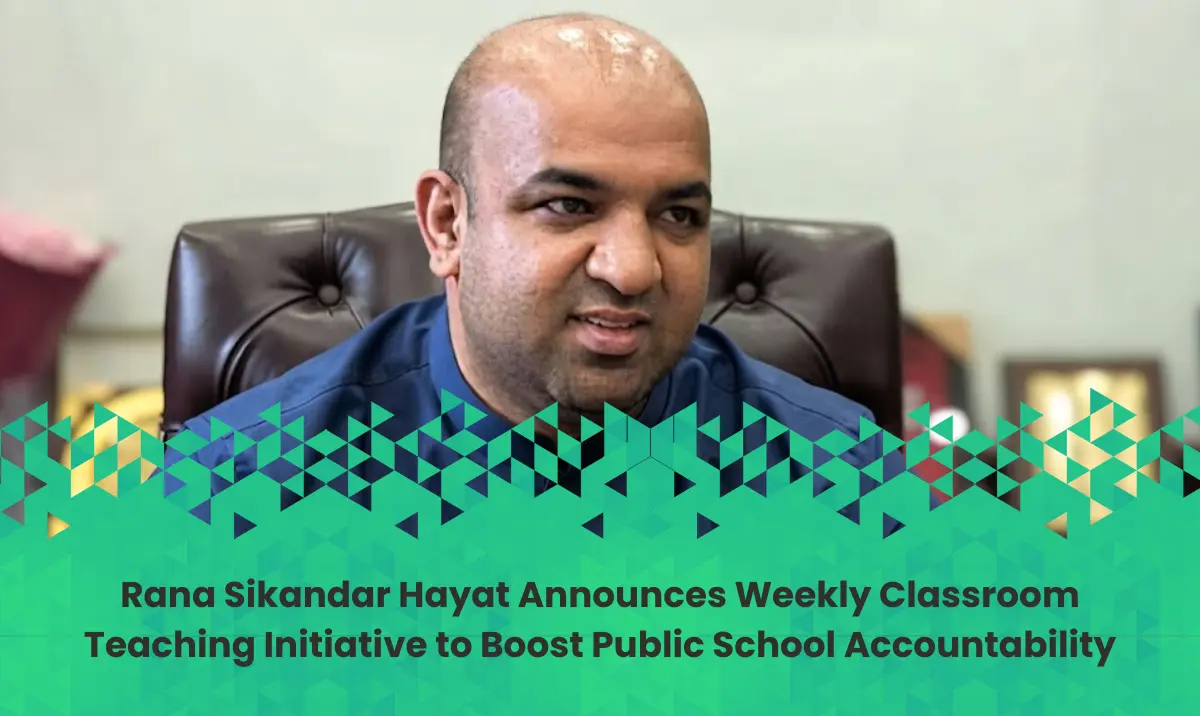
Punjab Education Minister Rana Sikandar Hayat to Teach Weekly Classes in Government Schools Under Groundbreaking Reform
In a bold and unprecedented move aimed at overhauling the public education framework, Punjab Education Minister Rana Sikandar Hayat has announced that he will personally teach in schools on a weekly basis. This high-profile initiative comes under direct instructions from Punjab Chief Minister Maryam Nawaz , who has placed education reform at the forefront of her provincial governance agenda. By stepping directly into public school classrooms, the leadership aims to bridge the long-standing disconnect between high-level policy formulation and ground-level implementation.
A New Paradigm in Educational Accountability and Classroom Engagement
For decades, critics of public schooling systems across South Asia have pointed to a recurring disconnect: policies designed in air-conditioned bureaucratic offices often fail to reflect the stark realities faced by teachers and students in under-resourced classrooms. To combat this, the directive requiring Punjab Education Minister Rana Sikandar Hayat to teach a class every week is designed to inject absolute transparency, direct accountability, and genuine empathy into the administrative machinery.
During a special high-level review meeting chaired by Chief Minister Maryam Nawaz, the structural framework of this initiative was laid out. Rather than relying solely on traditional inspection reports submitted by district officers—which can sometimes be filtered or sanitized—the education minister will experience the day-to-day ecosystem of government schools first-hand.
-
Direct Student Interaction: Engaging directly with children to gauge learning outcomes and comprehension levels.
-
Teacher Support: Understanding the operational hurdles, resource constraints, and pedagogical pressures faced by public school educators.
-
On-Ground Auditing: Evaluating infrastructure, cleanliness, availability of learning materials, and overall school environment without advance notice staging.
Broader Educational Reforms Under Chief Minister Maryam Nawaz
The weekly classroom teaching initiative does not stand alone; it is part of a sweeping, multi-pronged overhaul championed by CM Maryam Nawaz’s administration. During the same strategic briefing, several milestones and complementary directives were unveiled to uplift the province's educational landscape:
1. Historic Public School Enrollment Targets Achieved
Officials briefed the meeting that the ambitious target of enrolling 4.3 million students in public schools had been successfully achieved within a span of just two years and four months. This milestone marks the highest genuine enrolment spike recorded in government institutions in recent history, signaling a renewed public trust in state-run schools.
2. Financial Reforms for Punjab Education Foundation (PEF) Teachers
In a major relief measure aimed at financial inclusion and security, the provincial government has made digital payment mandatory for the salary disbursement of teachers working under the Punjab Education Foundation (PEF). This progressive step ensures that formal bank accounts will be established for over 138,000 PEF teachers , eliminating traditional bottlenecks and ensuring transparency.
3. Regulation and Digital Mapping of Private Entities
Recognizing the rapid commercialization of education, the chief minister ordered an immediate review of the digital registration mechanism for private schools. Furthermore, strict proposals were sought for the official registration and digital mapping of tuition centres across Punjab to monitor academic standards and curb unregulated commercial exploitation.
Bridging the Policy-Implementation Gap
The decision for a senior provincial minister to take up chalk and board has drawn widespread public attention and generated massive discussions across media platforms. Educationists have long argued that sustainable reform requires leadership to experience systemic flaws intimately. When a policymaker sits with students, evaluates textbook applicability, and listens to teachers' grievances directly inside a classroom, subsequent policy documents transform from theoretical suggestions into practical solutions.
By championing transparency, digital governance, and personal accountability, the Punjab government is signaling a decisive break from status-quo politics. The success of Rana Sikandar Hayat teaching weekly classes could well serve as a national benchmark for administrative diligence and public service delivery across Pakistan.








Share your comments & questions here
No comments yet. Be the first to comment!