




 Home
Home
 City Wise Admissions
 Level wise Admissions
 Category wise Admissions
 Popular Admissions


Admission Open in Abasyn University Peshawar
Posted Date
Last Date
City



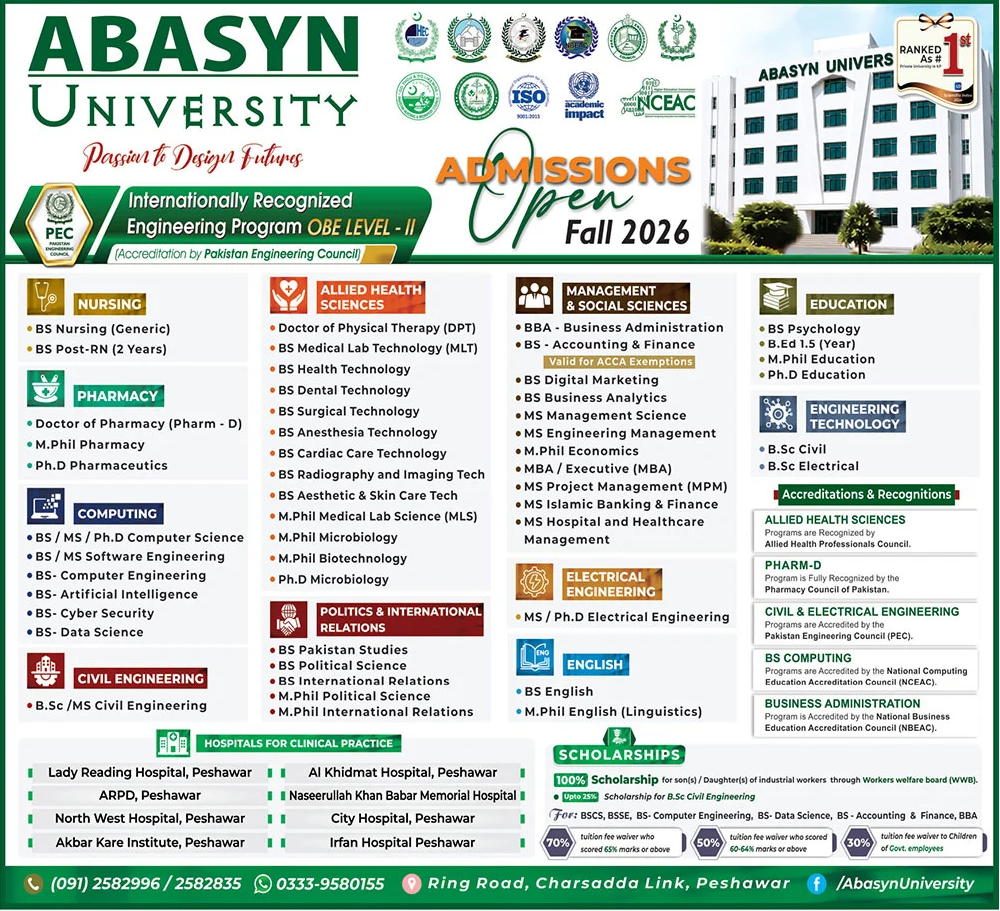
This document is a comprehensive academic prospectus or promotional brochure for Abasyn University, specifically advertising its programs and admissions for the Fall 2026 semester. The university is located on Ring Road, Charsadda Link, Peshawar.
The text serves multiple purposes:
-
Promoting Academic Programs: It lists a wide array of degree offerings across various disciplines, including Nursing, Pharmacy, Computing, Engineering, Allied Health Sciences, Management, Social Sciences, and English.
-
Highlighting Accreditations: It emphasizes the university’s credibility by listing accreditations from national bodies like the Pakistan Engineering Council (PEC), National Computing Education Accreditation Council (NCEAC), and the Pharmacy Council of Pakistan.
-
Advertising Clinical Affiliations: It lists several major hospitals in Peshawar (e.g., Lady Reading Hospital) where students can gain clinical practice.
-
Detailing Scholarship Opportunities: It outlines various merit-based and need-based scholarships, including waivers for high-achieving students, children of government employees, and children of industrial workers.
Text Format Analysis
The text is structured using a combination of headings, bullet points, bold text, and graphical elements to create a visually organized and easily scannable document. Below is a breakdown of its key formatting features:
1. Header and Branding:
-
Top: Contains the university name ("ABASYN UNIVERSITY") and its motto ("Passion to Desiezen Futures").
-
Accreditation Badge: Features "PEC" and the status "Internationally Recognized Engineering Program OBE LEVEL - II".
-
Utility Buttons: Includes icons for "ISO", "academic impact", and "NCEAC" to quickly convey credibility.
2. Main Section Headers (Bold & Capitalized):
The content is divided into broad academic faculties. These are clearly delineated with bold, all-caps headings:
-
NURSING
-
PHARMACY
-
COMPUTING
-
CIVIL ENGINEERING
-
ALLIED HEALTH SCIENCES
-
POLITICS & INTERNATIONAL RELATIONS
-
MANAGEMENT & SOCIAL SCIENCES
-
ELECTRICAL ENGINEERING
-
ENG (ENGLISH)
3. Sub-Headers and Program Listings:
-
Sub-Headers: Indicate specific program groups, often using bold text (e.g., BS Nursing (Generic) ).
-
Degree Lists: Degrees are often listed with a dash (e.g.,
BS/MS/Ph.D Computer Science). Related or specializations are grouped together (e.g.,BS- Artificial Intelligence,BS- Cyber Security).
4. Supplementary Information Blocks:
-
Clinical Practice Hospitals: This section is set apart with a separate heading and uses bullet points (•) for each hospital name.
-
Accreditations & Recognitions: This is a crucial section that uses sub-headings (ALLIED HEALTH SCIENCES, PHARM-D, etc.) followed by descriptive sentences to explain the accreditation status. Bold text is used to highlight the accrediting bodies (e.g., Pakistan Engineering Council (PEC)).
5. Scholarship Section:
This section uses a visual format with large, highlighted text and symbols to draw attention:
-
Large, colored text: "100% Scholarship"
-
Bold percentages: "Upto 25%" for Civil Engineering.
-
Bold, colored boxes: The percentages (70%, 50%, 30%) are visually set apart.
-
Bullet points for clarity: Conditions and criteria are listed with bullet points.
6. Visual and Contact Elements:
-
Graphics: Includes decorative symbols like "■" and "صو".
-
Contact Information: Phone numbers are clearly displayed at the bottom of the clinical section.
-
Social Media/Website: Includes a symbolic " / " indicating a web address or social media handle (likely
Abasyn University). -
Footer/Ranking Badge: The text "RANKED" and "EDUCATION" suggests a ranking badge, and it lists other programs like
BS Psychology.
7. Typography and Emphasis:
-
Bold Text: Used extensively for headings, sub-headings, and key phrases to improve readability.
-
Line Breaks: The text makes good use of line breaks to separate sections, preventing the text from becoming a dense block.
-
Symbols: Bullet points (• and ■) are used to organize lists, making them easier for the reader to digest.





Share your comments & questions here
No comments yet. Be the first to comment!